

Florida E-Bike Laws: What Wellington Riders Need to Know |
Age, ID, speed and park restrictions are now enforceable for e-bikes, e-scooters and other motorized devices. |
Citations have started
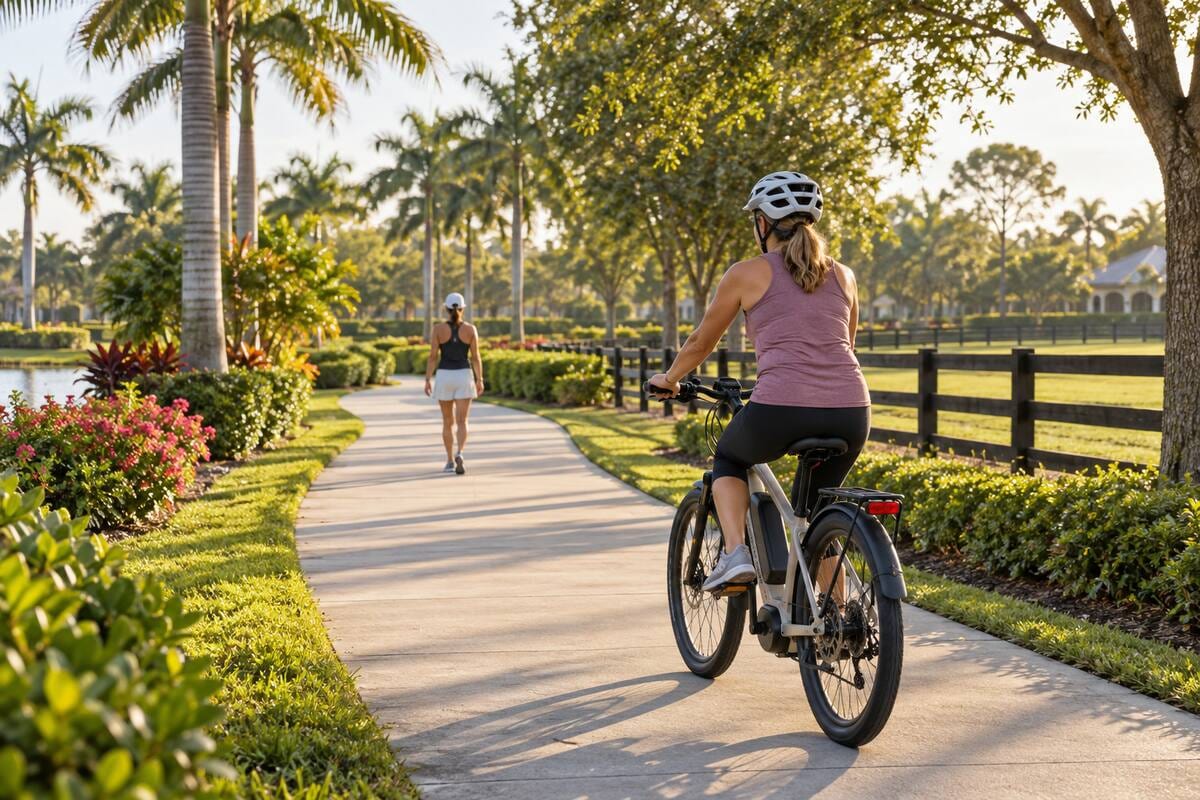
Wellington riders now face enforceable local rules for e-bikes, electric scooters and other motorized micromobility devices.
The Village Council adopted Ordinances 2026-16 and 2026-17 on August 11, 2026, covering public rights-of-way and parks.
After education and warning periods, written citations began October 1, making this a timely moment for households to review both the local requirements and broader Florida e-bike laws.
The Village’s ordinance announcement documents the phased rollout from verbal guidance to written warnings and citations.
Who the rules cover
The local requirements apply to all Class 1, Class 2 and Class 3 e-bikes, all motorized scooters, and other motor-equipped micromobility devices.
They apply on Wellington’s public roads, sidewalks, pathways and public rights-of-way, but not inside gated communities or on private property.
Golf carts are regulated separately, and wheelchairs are not treated as micromobility devices under these ordinances.
Age and identification
Operators of non-human-powered devices must be at least 15 years old.
They must also carry government-issued photo identification showing, at minimum, the operator’s name, address and date of birth.
For riders younger than 16, a properly fitted helmet remains mandatory, including for passengers when applicable.
The Village encourages helmets for riders of every age, a sensible precaution even when the law does not require one.
Speed and passing rules
On sidewalks and multi-modal pathways, motorized micromobility devices have a 15 mph maximum speed.
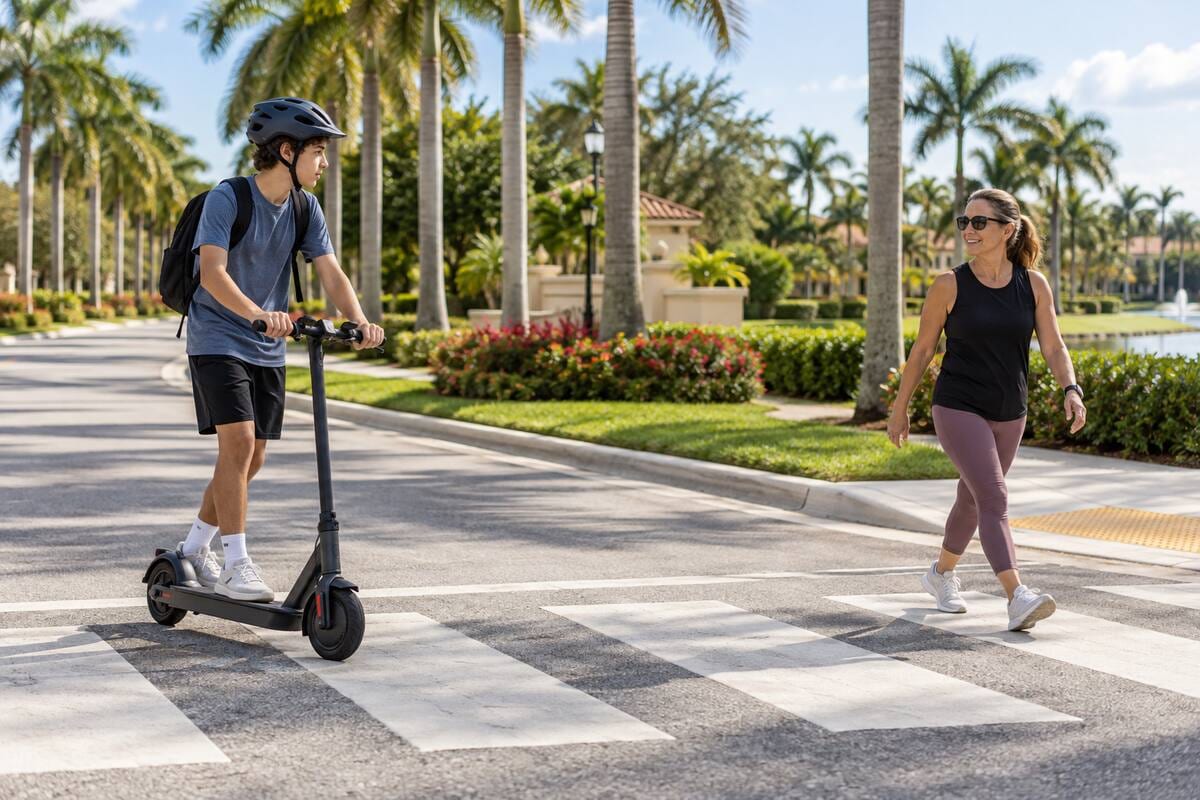
When using a sidewalk or crosswalk, every micromobility rider must yield to pedestrians and give an audible signal before passing.
That means slowing early, leaving room and avoiding a surprise pass from behind. |
 |
Roadway and nighttime basics
A rider traveling below the normal speed of traffic must use the bicycle lane when one is available.
Where there is no bicycle lane, the rider should travel as close as practicable to the right-hand curb or roadway edge.
Between sunset and sunrise, the device must have a front lamp and rear reflector that meet statutory requirements.
These statewide provisions work alongside Wellington’s local rules, so checking only one set can leave an important gap.
Where motorized devices cannot go
Motorized micromobility devices are prohibited on Wellington’s public bridle trails, reflecting the need to protect riders and horses sharing the equestrian network.
They also may not be operated at Wellington Town Center, in neighborhood parks, or on the Heart Trail at Village Park during the days and times shown on posted signs.
Broader park rules prohibit bicycling, e-biking, skateboarding and scootering in several specific areas, including boat docks, turf, playground equipment, sports courts and parking lots.
Because restrictions vary by setting, posted signs should guide the final decision on site.
Enforcement and a practical family check
The Palm Beach County Sheriff’s Office enforces the rights-of-way ordinance, while deputies and Village Parks staff may enforce the parks rules.
Rights-of-way violations can bring a civil citation tied to the state penalty for a pedestrian violation.
Park violations can carry more serious penalties under Chapter 14, so riders should not assume every restricted location is handled the same way.
Before the next ride, confirm the operator’s age, pack photo ID, check the helmet fit and lights, review the route, and set the device’s speed expectations.
Parents should also separate neighborhood permission from public-road permission because a gated community may have its own rules.
For the current text, maps and ordinance links, use Wellington’s official micromobility guide and check posted notices before riding.
A five-minute equipment and route check can prevent confusion once the trip begins. |
35 Comments
Join the conversation
It is helpful to see that the sidewalk speed limit is 15 mph, not a limit stated for every road. The location makes a difference when explaining this to riders.
The rules seem reasonable, but I hope enforcement focuses on unsafe riding rather than someone briefly forgetting their ID. The safety issues on sidewalks should come first.
I walk with my dog on public pathways, and quiet scooters can catch us off guard. Giving an audible warning before passing should help everyone share the space.
The October 1 citation date came up quickly. I hope there are still signs around Wellington reminding people about the speed and passing rules.
Reminders would be helpful, especially now that citations have begun. We haven’t confirmed where signs are posted, but the key sidewalk and pathway rules are a 15 mph maximum, yielding to pedestrians and giving an audible signal before passing.
Does anyone know where the Village posts the full park rules? I see parks are covered by one of the ordinances, and I would like to read those details.
Thanks for asking. The Village’s ordinance announcement is a good starting point. Look for the full text of Ordinances 2026-16 and 2026-17 for the park provisions.
I support keeping scooters from surprising people on sidewalks. An audible signal is simple enough, though riders should also slow down and give walkers space.
Alex J.Exactly. A bell helps, but it doesn't give someone much time to move if the scooter is already right behind them.
The rules for passengers under 16 caught my attention. If a child is riding along, the helmet requirement still applies, and that is easy to miss.
I appreciate the distinction between public paths and private property. It helps to know where Wellington can enforce these ordinances and where different rules may apply.
My son just turned 15 and uses an e-bike to visit friends. The ID requirement is the part we had not heard about, so we will look into that.
Fifteen miles an hour can still feel fast when someone passes close on a sidewalk. Leaving room for walkers matters as much as staying under the limit.
Paul RichardsAgreed. I walk with my kids, and a close pass feels startling even when the rider isn't speeding.
I am glad the rules cover Class 1, 2 and 3 e-bikes. It would be confusing if families had to guess whether their particular motor setting counted.
Sofia L.Same here. One set of local rules for all three classes is easier to explain at home.
We have both a regular bike and an e-bike at home, so the wording about motor-equipped devices matters. I will be checking which rules apply before our next ride.
That distinction is worth checking. Wellington’s age and ID requirements apply to operators of non-human-powered devices, while its sidewalk and crosswalk rules say every micromobility rider must yield to pedestrians and signal before passing.
Ben CarterWe have the same mix at home. The age and ID rules are the ones I need to go over with my teenager.
The crosswalk rule is easy to overlook. Riders need to yield to pedestrians there too, even when they are only crossing the street for a moment.
I would like more detail on how the 15 mph limit will be enforced on pathways. A clear rule is helpful, but riders also need to understand what to expect.
George M.I'd like to know that too. Will officers measure speed, or focus on riders who are clearly going too fast?
The phased rollout seems fair to me. Verbal guidance and written warnings gave riders a chance to learn the rules before citations began.
I use a scooter for short trips and can live with slowing down around pedestrians. The harder part is getting everyone to follow the passing rule consistently.
The helmet rule for riders under 16 is one parents should remember. I would still want my older kids wearing one, even if it is not required.
A lot of people seem to group golf carts in with e-bikes. Knowing they are regulated separately should clear up at least some confusion around Wellington.
I am glad wheelchairs are excluded from the micromobility rules. That distinction matters when people are trying to understand who needs to follow the new requirements.
It helps to know these rules do not apply inside gated communities. Residents there should still check what their own community allows on its roads and paths.
The photo ID requirement may be tricky for some 15-year-olds. I hope the Village explains what kind of government ID they can get if they do not drive.
I am surprised riders have to be 15 to operate these devices. That is worth telling families before a younger kid takes an e-bike out on a public sidewalk.
The audible signal before passing is a useful rule. I walk the pathways most mornings, and a little warning makes a big difference when someone comes up behind me.
The 15 mph limit on sidewalks and pathways sounds reasonable. I would like to know how riders are supposed to judge their speed if their scooter has no display.
That’s a practical question. If the scooter has no display, a securely mounted speedometer or GPS speed app could help. When in doubt, ride well below 15 mph on sidewalks and pathways.
I knew Wellington was discussing e-bike rules, but I missed that citations started October 1. The warning period gave people some time to adjust.
The rollout did move from guidance to warnings before written citations began October 1. Thanks for helping get the word out.